Leaping reality in a single bound
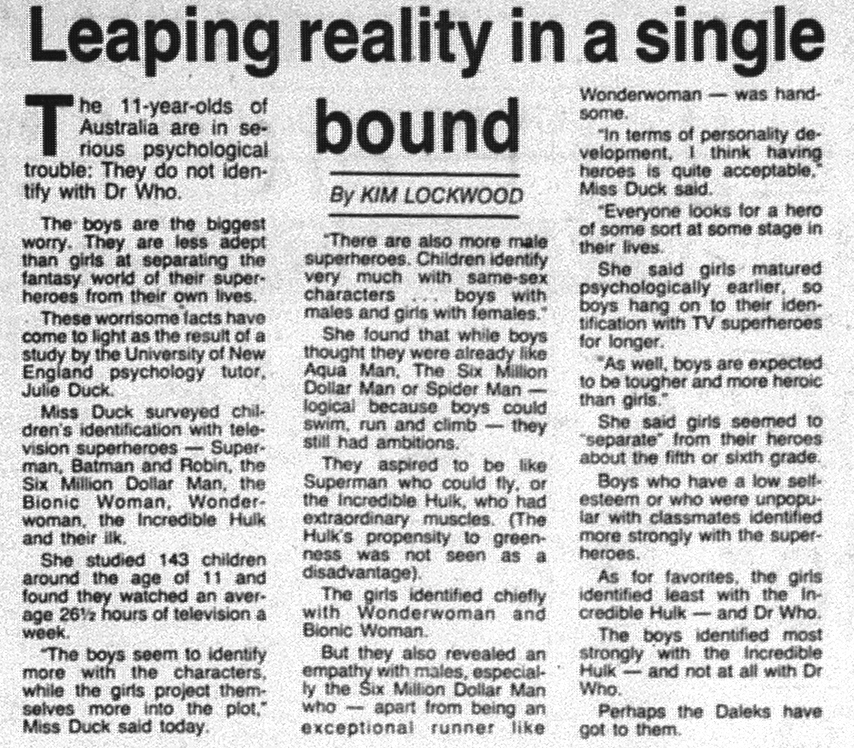
- Publication: The Herald (Australia)
- Date: 1984-07-04
- Author: Kim Lockwood
- Page: 24
- Language: English
The 11-year-olds of Australia are in serious psychological trouble: They do not identify with Dr Who.
The boys are the biggest worry. They are less adept than girls at separating the fantasy world of their superheroes from their own lives.
These worrisome facts have come to light as the result of a study by the University of New England psychology tutor, Julie Duck.
Miss Duck surveyed children's identification with television superheroes Superman, Batman and Robin, the Six Million Dollar Man, the Bionic Woman, Wonderwoman, the Incredible Hulk and their ilk,
She studied 143 children around the age of 11 and found they watched an average 26 1/2 hours of television a week.
The boys seem to identify more with the characters, while the girls project themselves more into the plot." Miss Duck said today.
"There are also more male superheroes. Children identify very much with same-sex characters boys with males and girls with females."
She found that while boys thought they were already like Aqua Man, The Six Million Dollar Man or Spider Man logical because boys could swim, run and climb still had ambitions.
They aspired to be like Superman who could fly, or the Incredible Hulk, who had extraordinary muscles. (The Hulk's propensity to greenness was not seen as a disadvantage).
The girls identified chiefly with Wonderwoman and Bionic Woman.
But they also revealed an empathy with males, especially the Six Million Dollar Man who apart from being an exceptional runner like Wonderwoman - was handsome.
"In terms of personality development. I think having heroes is quite acceptable. Miss Duck said.
"Everyone looks for a hero of some sort at some stage in their lives.
She said girls matured psychologically earlier, so boys hang on to their identification with TV superheroes for longer.
As well, boys are expected to be tougher and more heroic than girls.
She said girls seemed to separate from their heroes about the fifth or sixth grade.
Boys who have a low self-esteem or who were unpopular with classmates identified more strongly with the superheroes.
As for favorites, the girls identified least with the incredible Hulk and Dr Who.
The boys identified most strongly with the Incredible Hulk and not at all with Dr Who.
Perhaps the Daleks have got to them.
Disclaimer: These citations are created on-the-fly using primitive parsing techniques. You should double-check all citations. Send feedback to whovian@cuttingsarchive.org
- APA 6th ed.: Lockwood, Kim (1984-07-04). Leaping reality in a single bound. The Herald (Australia) p. 24.
- MLA 7th ed.: Lockwood, Kim. "Leaping reality in a single bound." The Herald (Australia) [add city] 1984-07-04, 24. Print.
- Chicago 15th ed.: Lockwood, Kim. "Leaping reality in a single bound." The Herald (Australia), edition, sec., 1984-07-04
- Turabian: Lockwood, Kim. "Leaping reality in a single bound." The Herald (Australia), 1984-07-04, section, 24 edition.
- Wikipedia (this article): <ref>{{cite news| title=Leaping reality in a single bound | url=http://cuttingsarchive.org/index.php/Leaping_reality_in_a_single_bound | work=The Herald (Australia) | pages=24 | date=1984-07-04 | via=Doctor Who Cuttings Archive | accessdate=19 January 2026 }}</ref>
- Wikipedia (this page): <ref>{{cite web | title=Leaping reality in a single bound | url=http://cuttingsarchive.org/index.php/Leaping_reality_in_a_single_bound | work=Doctor Who Cuttings Archive | accessdate=19 January 2026}}</ref>

