Master of the Whoniverse
- Publication: Radio Times
- Date: 2023-12-16
- Author: Alan Yentob
- Page: 12
- Language: English
His childhood obsession became his possession. As Russell T Davies takes charge of Doctor Who for a second time, Alan Yentob reveals how the allure of the Time Lord nurtured one of our greatest TV writers
Once upon a time there was a little boy from Swansea called Russell, who had an amazing brain. He grew up to be Russell T Davies, one of the greatest television writers of the 21st century. "My mum and dad were lovely," he tells me in our Imagine special, recorded over the last 18 months. "They were both teachers and I have two sisters. It was a very happy home." But Russell always felt a little bit different from other children around him in south Wales. For a start he didn't like rugby.
He found solace in his favourite television show. Russell fell in love with Doctor Who when he was three years old. It was his first television experience, the first thing he remembers in life — seeing the original Doctor, William Hartnell, regenerate into Patrick Troughton in 1966. Then, when he was four, Russell encountered the Cybermen. "I can remember it being so scary," he says. "White-hot inside of me. It's the stuff of fairy tales. The stuff of witchery. The stuff of nightmares..."
From then on, he never fell out of love with the Doctor or with TV. You could call it an addiction. Russell loved Crossroads, he loved Coronation Street, he lived in the world of TV. Even when, ferociously bright, he went to Oxford University to study English literature, Russell complained because Doctor Who was on at the same time as the rugby, so he didn't get to watch it.
A lot of people might be a bit snotty about a boy who never stops watching TV, day and night, but it allowed him to flourish. Russell was always a storyteller, gifted with astonishing creativity and imagination. Television liberated those talents. His instincts in the early days, as a child, were to draw and he would create Doctor Who comic strips when the other boys were outside chasing a ball.
Television also gave him a real understanding of human nature and a real ability to address it. It allowed him to understand his own life. Russell knew he was gay when he was around 13. It wasn't something he could talk about, he had to keep it to himself. When he was turning 16, the country was scandalised by the details of the Jeremy Thorpe trial in 1979 — when the patrician former leader of the Liberal Party was accused of trying to murder his lover, Norman Scott. The trial made it even harder for Russell to admit who or what he was. "It wasn't a story that would make you come out of the closet, was it?" he says. "It was one of those stories that said: Stay in there!"
But it was a story, one of the many that Russell collected and stored away in his head only to emerge as jewel-like television scripts years later. His vivid memories of the Thorpe trial were ignited when the BBC invited him to turn John Preston's 2016 book about the case, A Very English Scandal, into a screenplay.
"I felt with a passion that I was absolutely the right person to tell that," Russell says of what became the acclaimed series with Hugh Grant and Ben Whishaw. "I was the gay man who should be telling the gay man's story."
I would argue that no one else has written so well, or bravely, about the gay experience for British television. His series It's a Sin, Cucumber and Queer as Folk are exceptional. I believe It's a Sin is a kind of masterpiece; I can't look at some of those extraordinary scenes without tears coming to my eyes.
And now he has returned to where he began, to the Doctor. This time it's on a different scale, thanks to a production partnership with Disney. Russell has a mammoth budget to work with, seven sound stages and huge sets; all not far from his house in the Mumbles, the picturesque village that lies across the bay from his childhood home in Swansea. Along with all this comes a huge responsibility. Doctor Who is now going worldwide, this really is the big time. Can Russell do it? "Yes," he tells me. "I have a divine right."
Captions:
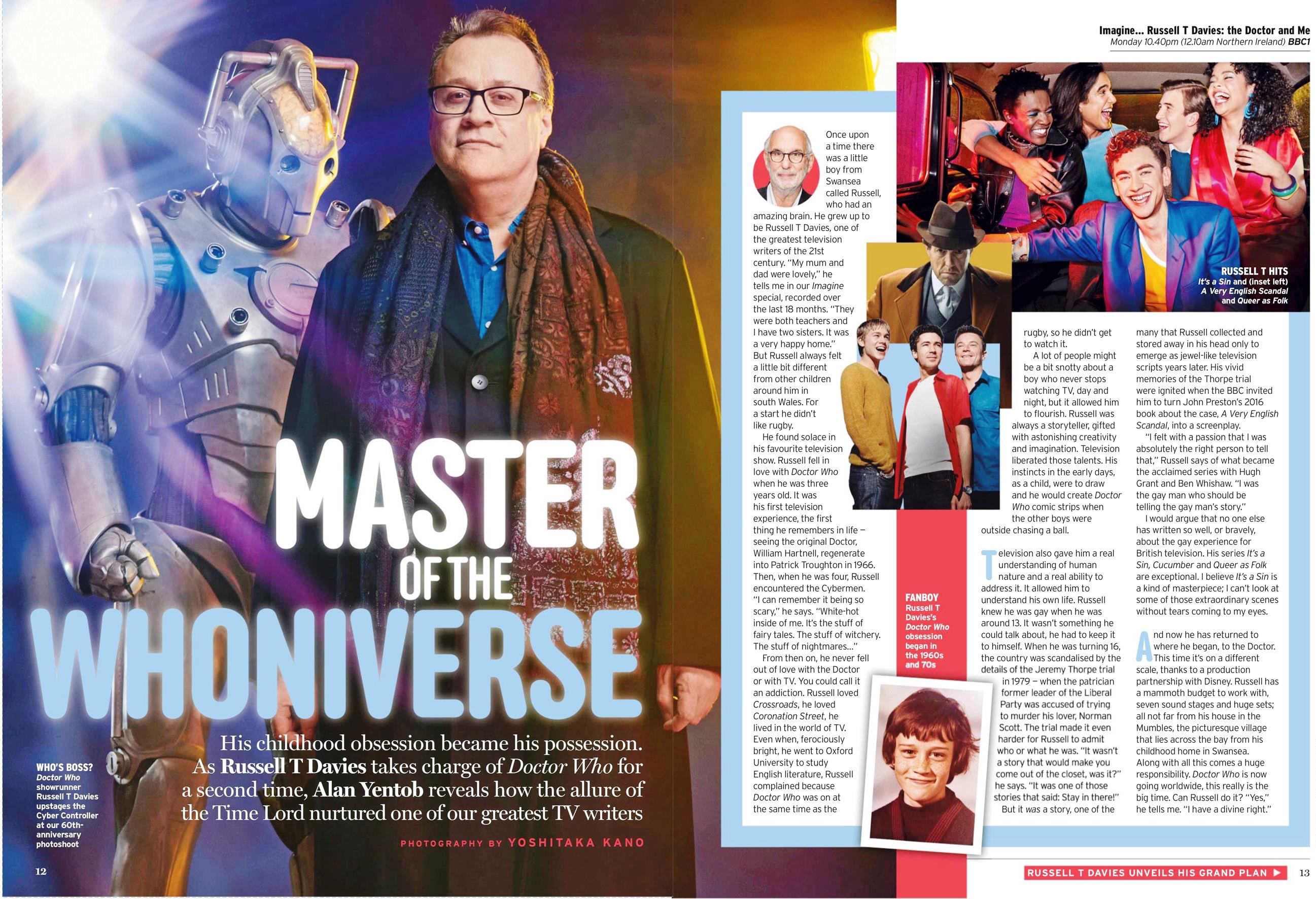
WHO'S BOSS? Doctor Who showrunner Russell T Davies upstages the Cyber Controller at our 60th-anniversary photoshoot
RUSSELL T HITS It's a Sin and (inset left) A Very English Scandal and Queer as Folk
FANBOY Russell T Davies's Doctor Who obsession began in the 1960s and 70s
Disclaimer: These citations are created on-the-fly using primitive parsing techniques. You should double-check all citations. Send feedback to whovian@cuttingsarchive.org
- APA 6th ed.: Yentob, Alan (2023-12-16). Master of the Whoniverse. Radio Times p. 12.
- MLA 7th ed.: Yentob, Alan. "Master of the Whoniverse." Radio Times [add city] 2023-12-16, 12. Print.
- Chicago 15th ed.: Yentob, Alan. "Master of the Whoniverse." Radio Times, edition, sec., 2023-12-16
- Turabian: Yentob, Alan. "Master of the Whoniverse." Radio Times, 2023-12-16, section, 12 edition.
- Wikipedia (this article): <ref>{{cite news| title=Master of the Whoniverse | url=http://cuttingsarchive.org/index.php/Master_of_the_Whoniverse | work=Radio Times | pages=12 | date=2023-12-16 | via=Doctor Who Cuttings Archive | accessdate=17 April 2026 }}</ref>
- Wikipedia (this page): <ref>{{cite web | title=Master of the Whoniverse | url=http://cuttingsarchive.org/index.php/Master_of_the_Whoniverse | work=Doctor Who Cuttings Archive | accessdate=17 April 2026}}</ref>

