What It's Like ... to choreograph Doctor Who and Bridgerton
- Publication: Radio Times
- Date: 2024-06-08
- Author: Robin Parke, Huw Fullerton
- Page: 8
- Language: English
Who better to teach the Time Lord to dance - than Regency ballroom master Jack Murphy?
This week, Doctor Who is doing a Bridgerton with its own spin on Regency romance and lavish balls - so who better for the team to recruit than Jack Murphy, who's choreographed every decadent dance in the hit Netflix show? Fresh from the Duchess's ball hosted by guest star Indira Varma (and working on Bridgerton series three, which returns with its second instalment this week), Murphy fills us in on what it's like to dance with the Doctor...
FIRST STEPS I trained as a classical actor. My favourite classes were movement and historical and social dance. I'd never had any formal dance training, but after studying European dance history from the 12th to the 19th century, I worked on the BBC's Pride and Prejudice and the movie Young Victoria before I was hired for Bridgerton.
STRICTLY START I screentested to be a judge on Strictly but didn't get it. In the middle of my interview, the fire alarm went off, we all left the building and I never saw the people who'd been interviewing me again! But I met Shirley Ballas on Doctor Who [she had a dancing cameo in the 60s Beatles episode]. She's electric. During filming, she asked me to do a Viennese waltz. I can't believe I got to dance with her — she has such energy and focus. And I got to do a rumba with the beautiful Johannes Radebe!
FROM THE TON TO THE TARDIS I had an email asking if I'd like to work on a production featuring a Regency ball, but with no indication what the show was. When they sent me a Doctor Who script, I was very bemused! I hadn't watched it since I was a kid. They approached me because I choreograph Bridgerton and can fuse the then and the now for a modern audience. Learning about song and dance planned for this year's 1960s episode, I was very cheeky and said, "I'll do the ball if you let me do that too, so I can get out of the 19th century for once."
HOT TO PLOT Dancing tells a story. It's never dancing for its own sake. I read a script and bring it to life with the director. Within any dance there should be a continuity of the overall narrative. I like to know what's happening to the characters. That helps actors feel comfortable.
CHOREO CORNER It starts in my kitchen. At 5am, I put the coffee on, put music on and start dancing by myself. Later, I workshop it with the dancers. For a four-dance ball on Bridgerton, eight of them will learn it in two days. Once people are moving in the space, it's a bit like working with clay. You start sculpting. I tell the actors that for every session they have with me, they should do three privately.
KEEP IT SIMPLE I don't use complicated dance language. I only get actors for a few sessions and don't want to frighten them. If they've not had any dance training, I ask if they do any sport and use that parallel physical language.
HAVING A BALL Balls are popular for drama because the rules and etiquette create conflict. Regency balls were hosted by the elite. You could only attend if you were a member of society. You'd have had the dancing master come to your house. Two reasons to dance are to have pleasure or give pleasure. On a show like Strictly, you're giving pleasure to the judges who give a score. A Regency ball is social dancing for one's own pleasure.
TWO TO TANGO A pas de deux is more complex to choreograph than a ball with 50 dancers. It's the intimacy. People who can dance solo can't necessarily dance the intensity of a close tango, where it's eyeball to eyeball, the camera's up close and it's all heightened. You reveal your natural rhythm and how comfortable you feel with your partner. Intimacy was often the raison d'être of the ball: you reveal if you're a leader, or want to be led.
SAFETY DANCE A choreographer is a safety officer, too. If people are dancing on tables, there's a lot of risk assessment. If a dancer steps on the train of an actor's dress and trips her up, I'm not doing my job properly.
REGENCY REVISION I like it when actors do their homework. Millie Gibson [Ruby in Doctor Who] is very young and isn't trained in dance. But she'd thought about it and came in saying, "I haven't been to dance class but I think this is what I need to wear." She was already on the front foot. She was fantastically open, and that's all you can ask for.
THE DOCTOR DANCES Ncuti Gatwa is an extraordinary dancer. He's a free spirit. He'll give anything a go. When he smiles, some kind of pulse goes through you. He has such energy. And when Jonathan Groff comes into a room, everybody has an out-of-body experience. It's unreal!
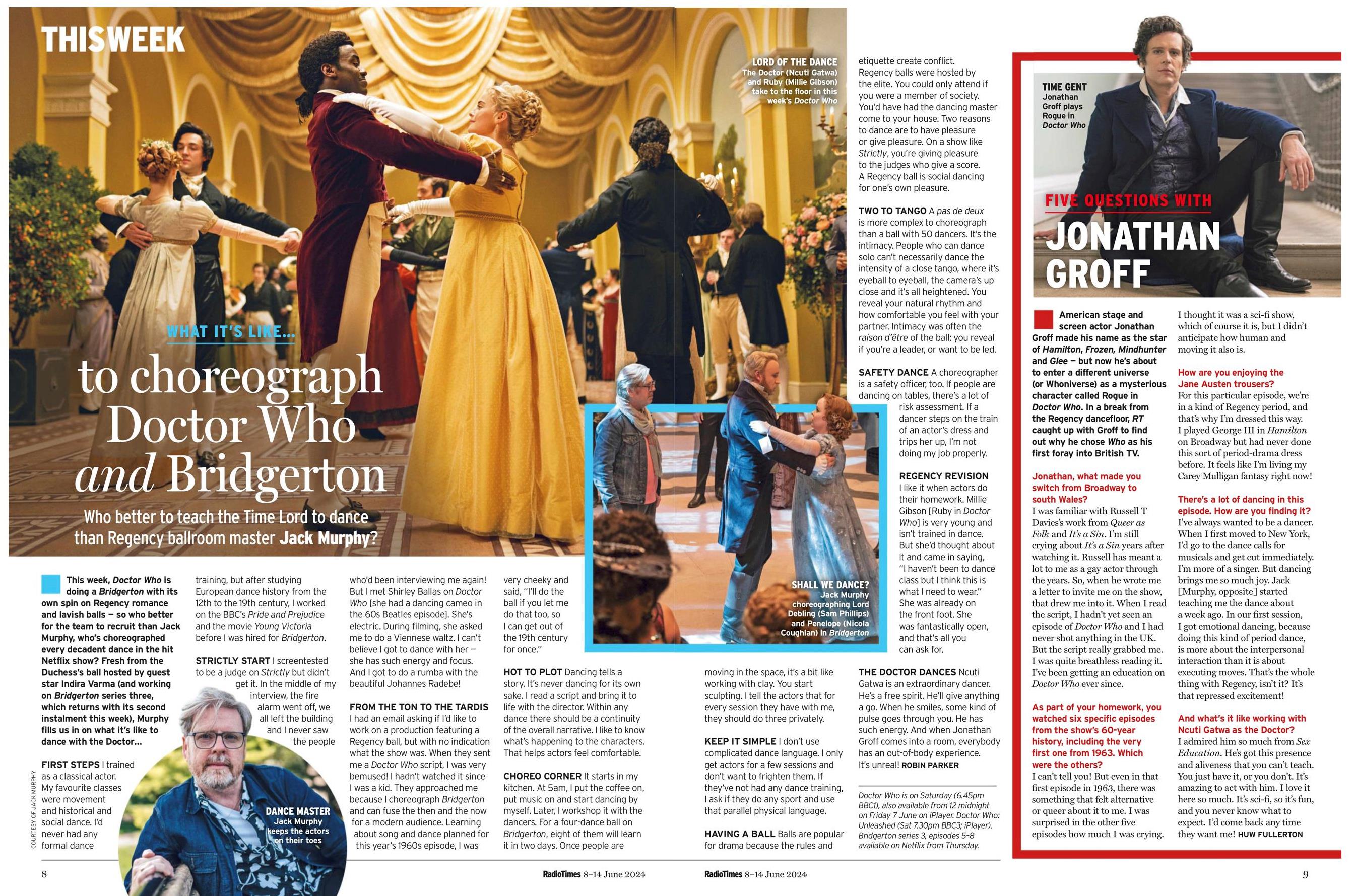
Caption: LORD OF THE DANCE The Doctor (Ncuti Gatwa) and Ruby (Millie Gibson) take to the floor in this week's Doctor Who
Caption: SHALL WE DANCE? Jack Murphy choreographing Lord Debling (Sam Phillips) and Penelope (Nicola Coughlan) in Bridgerton
Five Questions with Jonathan Groff
American stage and screen actor Jonathan Groff made his name as the star of Hamilton, Frozen, Mindhunter and Glee - but now he's about to enter a different universe (or Whoniverse) as a mysterious character called Rogue in Doctor Who. In a break from the Regency dancefloor, RT caught up with Groff to find out why he chose Who as his first foray into British TV.
Jonathan, what made you switch from Broadway to south Wales?
I was familiar with Russell T Davies's work from Queer as' Folk and It's a Sin. I'm still crying about It's a Sin years after watching it. Russell has meant a lot to me as a gay actor through the years. So, when he wrote me a letter to invite me on the show, that drew me into it. When I read the script, I hadn't yet seen an episode of Doctor Who and I had never shot anything in the UK. But the script really grabbed me. I was quite breathless reading it. I've been getting an education on Doctor Who ever since.
As part of your homework, you watched six specific episodes from the show's 60-year history, including the very first one from 1963. Which were the others?
I can't tell you! But even in that first episode in 1963, there was something that felt alternative or queer about it to me. I was surprised in the other five episodes how much I was crying.
I thought it was a sci-fi show, which of course it is, but I didn't anticipate how human and moving it also is.
How are you enjoying the Jane Austen trousers?
For this particular episode, we're in a kind of Regency period, and that's why I'm dressed this way. I played George III in Hamilton on Broadway but had never done this sort of period-drama dress before. It feels like I'm living my Carey Mulligan fantasy right now!
There's a lot of dancing in this episode. How are you finding it?
I've always wanted to be a dancer. When I first moved to New York, I'd go to the dance calls for musicals and get cut immediately. I'm more of a singer. But dancing brings me so much joy. Jack [Murphy, opposite] started teaching me the dance about a week ago. In our first session, I got emotional dancing, because doing this kind of period dance, is more about the interpersonal interaction than it is about executing moves. That's the whole thing with Regency, isn't it? It's that repressed excitement!
And what's it like working with Ncuti Gatwa as the Doctor?
I admired him so much from Sex Education. He's got this presence and aliveness that you can't teach. You just have it, or you don't. It's amazing to act with him. I love it here so much. It's sci-fi, so it's fun, and you never know what to expect. I'd come back any time they want me!
Caption: TIME GENT Jonathan Groff plays Rogue in Doctor Who
Disclaimer: These citations are created on-the-fly using primitive parsing techniques. You should double-check all citations. Send feedback to whovian@cuttingsarchive.org
- APA 6th ed.: Fullerton, Robin Parke, Huw (2024-06-08). What It's Like ... to choreograph Doctor Who and Bridgerton. Radio Times p. 8.
- MLA 7th ed.: Fullerton, Robin Parke, Huw. "What It's Like ... to choreograph Doctor Who and Bridgerton." Radio Times [add city] 2024-06-08, 8. Print.
- Chicago 15th ed.: Fullerton, Robin Parke, Huw. "What It's Like ... to choreograph Doctor Who and Bridgerton." Radio Times, edition, sec., 2024-06-08
- Turabian: Fullerton, Robin Parke, Huw. "What It's Like ... to choreograph Doctor Who and Bridgerton." Radio Times, 2024-06-08, section, 8 edition.
- Wikipedia (this article): <ref>{{cite news| title=What It's Like ... to choreograph Doctor Who and Bridgerton | url=http://cuttingsarchive.org/index.php/What_It%27s_Like_..._to_choreograph_Doctor_Who_and_Bridgerton | work=Radio Times | pages=8 | date=2024-06-08 | via=Doctor Who Cuttings Archive | accessdate=2 May 2026 }}</ref>
- Wikipedia (this page): <ref>{{cite web | title=What It's Like ... to choreograph Doctor Who and Bridgerton | url=http://cuttingsarchive.org/index.php/What_It%27s_Like_..._to_choreograph_Doctor_Who_and_Bridgerton | work=Doctor Who Cuttings Archive | accessdate=2 May 2026}}</ref>

